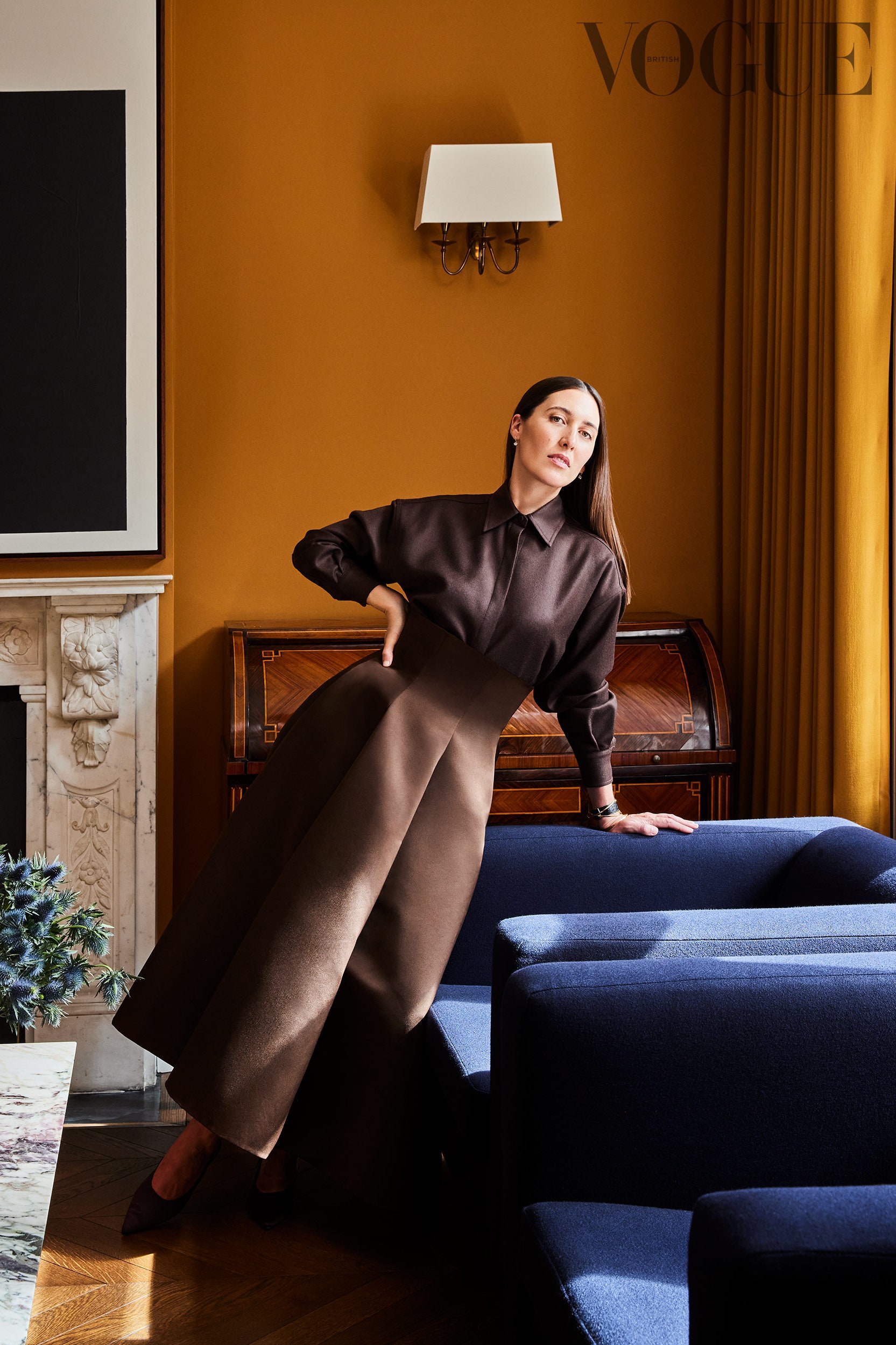
When Emilia Wickstead was 11 years old, she was discovered by her mother, wedged beneath a collapsed wardrobe. “I’d been moving furniture around in my bedroom,” smiles the 39-year-old, Auckland-born, West London-based fashion designer. “I was moving pieces around constantly.”
What doesn’t concuss you, seemingly, makes you stronger. Wickstead’s interior design ambition (not to mention her interest in women’s wardrobes), never waned. Before she moved into the spacious, light-filled flat she shares with her husband Daniel, nine-year-old daughter Mercedes Amalia and seven-year-old son Gilberto in 2018 – housed in a regal red-brick mansion block built at the turn of the 19th century – she had files bulging with references. “I had a wall in our last place, for collecting inspiration for our new one,” she says, with a smile.
Emilia Wickstead photographed in her West London home. A pair of newly installed double doors lead into a light-filled dining room. Emilia wears an Emilia Wickstead dress and shoes.
Kate Martin
The statuesque, seamless and luxurious materiality of the Milanese apartments that Wickstead grew up in from age 14 (before a move to London to study fashion design and marketing at Central Saint Martins) inspired her four-month renovation. “We ripped everything out,” she explains. Laminate flooring was stripped back, entrances widened, ceilings raised, pairs of palazzo-worthy double doors installed, walls painted in shades of Tuscan mustard, and the kitchen, two bathrooms and entrance hall swathed in slabs of Arabescato and Calacatta Viola marble, imported with the help of family friends. “I don’t know how it happened, but it’s everywhere,” Wickstead laughs when we meet, on a working-from-home Friday, gesticulating enthusiastically to the chequerboard, Venice-inspired marble floor of her hallway. She pads across the entrance barefoot, a pair of pointed satin kitten heels slipped off near her front door, refined yet totally relaxed in a chic 1940s-style dress of her own design. She also namechecks Italian architect and marble fanatic Piero Portaluppi, who designed Milan’s landmark Villa Necchi Campiglio between 1932 and 1935 and swathed his buildings in patchworks of the veiny stone.
Wickstead’s refined fashion designs revel in the regality and classicism of old-world glamour, fitting for chic soirées and garden parties, and beloved by aristocratic and A-list clients alike, from the Princess of Wales to Zawe Ashton, Princess Eugenie to Alexa Chung. It’s unsurprising then, that the four walls of her dining room were the only ones newly built into her home’s predominantly interconnecting floorplan. “I like setting up a room and having an intimate entertaining space, separate for eating breakfast and dinner as a family,” she says, morning light pouring through the space’s capacious windows.
,
A painting by New Zealand artist Annette Isbey hangs in the dining room.
Kate Martin
Floral linen napkins from her 2018-launched homeware line are an everyday table fixture, and Wickstead is constantly on the hunt for silver and crystalware. “I never save anything for a special occasion,” she says, pouring us fresh mint tea from a teapot by French porcelain expert Legle. She also confesses an affection for the “city-slick power lunching era” of the 1950s; cue the polished chrome and leather Mies van der Rohe-designed Knoll Brno armchairs plus bar stools, created for Philip Johnson’s interior for the Pool and Grill Rooms at The Four Seasons restaurant in Manhattan. Emilia’s one strict serving rule? “No plastic at the table!”
The rooms of Wickstead’s home are an amalgam of rigorously considered, well-travelled pieces – a mix of finessed flea-market finds, collector’s items invested in piece by piece over time, and family heirlooms that reflect her peripatetic adolescence and her Brazilian husband Daniel’s heritage. They also show off Wickstead’s personal penchant for a paintbrush. In the living room, a matching antique cupboard and writing desk, crafted from painstakingly inlaid wood, found in a shop in Odalengo Piccolo, in Italy’s Piedmont region, and a mainstay of their previous homes, is transformed into a liquor cabinet and cocktail station at Christmas parties. They neighbour second-hand cricket stools and a sizeable coffee table, both resurfaced with marble, and a sofa that Wickstead and her husband gifted to each other as a wedding present in 2011, reupholstered in rich navy wool. The futurist-leaning monochromatic canvas that hangs in striking juxtaposition to an original ornate mantelpiece, festooned with carved flowers? The result of Wickstead’s own hand, coated in thick house paint.
,
